

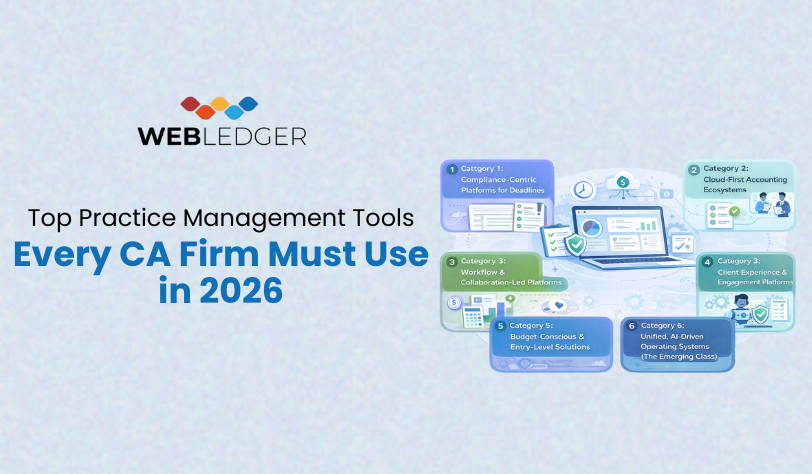
Top Practice Management Tools Every CA Firm Must Use in 2026
CA firms today aren’t struggling because of a lack of expertise, they’re struggling because traditional tools were never designed for the velocity, compliance density, and client expectations of a digital-first economy. Between GST, TDS, audits, income tax, loan documentation, and real-time client communication, even well-run firms feel stretched.
Spreadsheets crack. Desktop software isolates data. WhatsApp creates chaos instead of clarity.
This is why platforms like WebLedger are increasingly part of conversations around next-generation practice management—because the problem is no longer about “doing work,” but about coordinating complexity at scale.
Practice Management Has Shifted From Control to Intelligence
For years, practice management meant tracking tasks and deadlines. In 2026, that definition is insufficient.
Modern CA practice management is about creating an operational nervous system for a firm—one where accounting data, compliance workflows, documents, approvals, and people move in sync. This evolution is especially critical for a growing CA firm, where the cost of inefficiency compounds quickly.
Your Growth Starts with
Webledger
Webledger
Let’s Talk!
×
Verify Your Mobile Number
We have sent a 6-digit OTP to your WhatsApp Number
Please enter the OTP below to proceed.
Please enter the OTP below to proceed.
Enter OTP
OTP Sent 60s
The most effective CA practice management systems today focus on:
- Workflow automation instead of manual follow-ups
- Single-source data instead of repeated entry
- Visibility across teams instead of status meetings
- Built-in compliance logic instead of human memory
Category 1: Compliance-Centric Platforms for Deadlines
Some firms operate in environments where regulatory precision is non-negotiable. These are audit-heavy practices, statutory specialists, and firms managing high volumes of GST, TDS, and ROC work.
ICAI Practice Management Software and CCH iFirm fall squarely into this category.
Their strength lies in:
- Structured compliance workflows
- Strong audit trails and documentation
- Security-first architecture
- Standardization across large teams
These tools are ideal when compliance risk outweighs flexibility. However, they can feel rigid for smaller or advisory-led firms that need speed and customization.
Category 2: Cloud-First Accounting Ecosystems
Another class of tools revolves around cloud accounting as the central anchor, with practice management layered on top.
Zoho Practice and Xero Practice Manager are prime examples.
They excel at:
- Real-time financial visibility
- Seamless accounting-to-workflow integration
- Dashboards for partners and managers
- Scalability across geographies
These platforms work best when firms are already invested in their respective accounting ecosystems. Their limitation isn’t capability—it’s dependency. Outside those ecosystems, their value reduces significantly.
Category 3: Workflow & Collaboration-Led Platforms
As teams become distributed and multi-layered, internal coordination has emerged as a major bottleneck. Platforms in this category prioritize “who is doing what, and by when.”
Karbon and ERPCA lead this space.
They focus on:
- Task ownership and accountability
- Workload balancing
- Recurring workflows and templates
- Team performance analytics
These tools are powerful for mid-to-large firms where coordination costs are high. However, they often rely on integrations for accounting and compliance, making them less self-contained.
Category 4: Client Experience & Engagement Platforms
Client expectations have changed dramatically. Faster responses, transparent billing, digital document exchange, and minimal friction are now baseline requirements.
Tax Dome and Practice Panther represent this category well.
Their strengths include:
- Client portals and communication tracking
- Billing, invoicing, and payment workflows
- E-signatures and document versioning
- Strong UX on both firm and client sides
These platforms shine where client interaction volume is high. The trade-off is that India-specific compliance workflows often require additional customization or external tools.
Category 5: Budget-Conscious & Entry-Level Solutions
Not every firm needs an enterprise-grade system. Solo practitioners and small firms often prioritize affordability and simplicity.
GenieBooks Practice Management and QuickBooks Practice Management cater to this segment.
They offer:
- Basic client and task management
- GST/TDS reminders
- Simple billing and reporting
- Lower learning curves
These tools are effective starting points but may struggle as client volume, compliance complexity, or team size increases.
Category 6: Unified, AI-Driven Operating Systems (The Emerging Class)
The fastest-growing category in 2026 is unified platforms that combine accounting, compliance, workflows, documents, and AI intelligence into a single environment.
This is where WebLedger distinguishes itself—not as a point solution, but as an operating system for firms and MSMEs.
They offer
- Cloud Accounting
- Gst Automation
- Audit Automation
- Cma Report Generation
- Task Management
- Secure Document Vaults
- Role-Based Access
under one roof, it addresses fragmentation at the root level.
For firms handling both MSME accounting and complex compliance, this unified approach reduces context switching, improves accuracy, and creates room for advisory-led growth.
Why AI is the Real Differentiator Going Forward?
“Across all categories, one trend cuts through: AI”
AI accounting tools are no longer experimental. In 2026, they are actively used for:
- Automated ledger scrutiny and anomaly detection
- Audit automation with Schedule III formatting
- Ratio analysis and financial insights
- CMA report generation for loan proposals
Firms adopting AI-first systems are not just faster—they’re structurally different. They spend less time validating data and more time interpreting it. This shift directly impacts margins, client trust, and professional satisfaction.
How a CA Firm Should Choose the Right Category?
There is no universal “best” software—only the best fit.
A firm should evaluate:
- Compliance intensity vs advisory focus
- Team size and geographic distribution
- Client expectations around visibility and speed
- Need for AI-driven automation
- Long-term scalability
The wrong category creates friction.
The right one becomes invisible—because work simply flows.
The Bigger Picture: Practice Management as Strategic Infrastructure
Practice management software is no longer a back-office decision. It’s a strategic one.
In a world of tighter regulations, smarter clients, and AI-powered competitors, firms that rely on fragmented systems will always be reactive. Firms that invest in connected and intelligent platforms position themselves to lead.
Conclusion: The Future Belongs to Firms That Think in Systems
CA professionals are entering in a systems era. Tools alone won’t create efficiency. Features alone won’t create differentiation.
What will matter is how intelligently a firm connects data, people, compliance, and insight. Unified platforms—such as WebLedger—reflect this future, where practice management is not just about control, but about clarity, confidence, and compounding value.